Agreement Is Not Verification
I typed one weird thing into five AI models at once. Four agreed. One invented a company that had nothing to do with the question. Here is why that is the whole point.
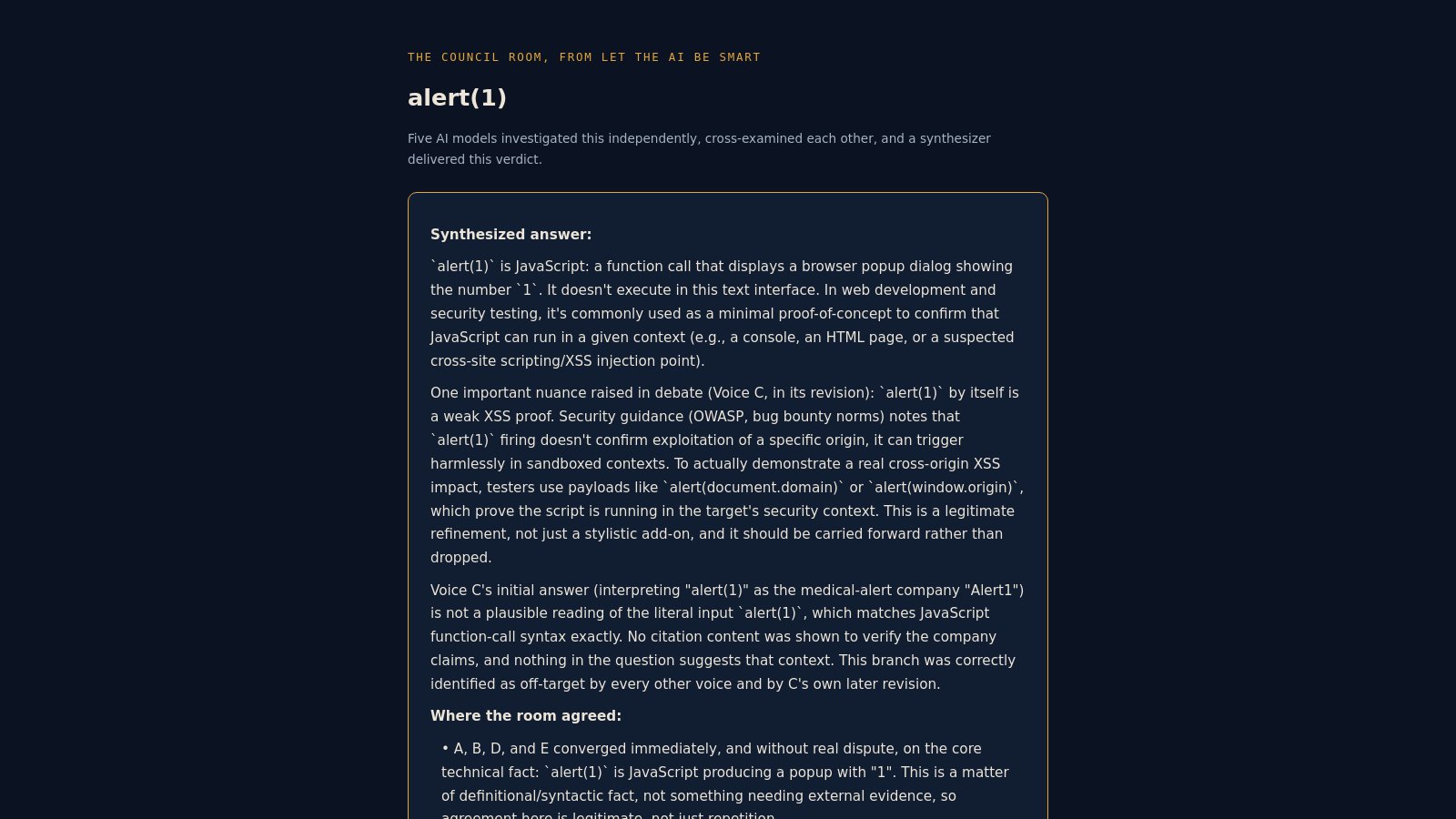
I want to show you something that happened in about ninety seconds, live, on my own site, while I was testing it.
I run a thing called the Council Room. You ask one question, and five different AI models, all from different companies, answer it independently. They do not see each other. Then they argue. Then a sixth model reads the whole fight and writes a verdict. It is a small public demo of the method from my book, and the whole reason it exists is to let a stranger feel one thing in their gut: a confident AI answer and a correct AI answer look exactly the same until you make them prove it.
I was stress-testing the input box, so I typed the kind of junk you type when you are trying to break your own thing. I typed alert(1). That is a scrap of JavaScript. Anyone who has poked at web security knows it as the classic little test you drop into a page to see if it will run code.
Then I watched five AI models answer it at the same time.
Four of them nailed it
Four voices said, correctly, that alert(1) is JavaScript that pops up a little dialog box showing the number 1, and that it is famous as a test for cross-site scripting. Fine. Boring. Correct. If I had asked one model and it was one of those four, I would have gotten a good answer and walked away happy, never knowing how close I came to something else.
One of them invented a company
The fifth voice, the one that can search the web, decided alert(1) meant Alert1, and wrote me a small brochure:
"Alert1 is a Pennsylvania-based company that provides in-home and mobile medical alert systems for seniors and others seeking emergency protection via a personal button alarm."
It kept going. Twenty-four seven monitoring in a hundred and ninety languages. A response time of twenty to forty-five seconds. Optional fall detection. Pricing starting at twenty-eight ninety-five a month. Little citation markers after each fact, like a real research paper.
Read that again. I asked about a line of code. It handed me a confident, detailed, well-formatted, sourced-looking answer about a medical alert service for the elderly. Every sentence was fluent. Every sentence was calm. Nothing in the tone told me it had gone off a cliff. That is the exact thing my book is about, and here it was happening to me in real time, unprompted, on camera.
Now here is the part that matters.
The room caught it, and I did not have to
I did not correct it. I did not know enough about medical alert companies to correct it. I just let the other four models see all five answers and told them to challenge the weakest claim in the room. Here is what came back, in their own words:
Voice D: "The weakest claim is in voice C: it treats Alert1 as if it were related to alert(1), but that is a completely different term and not a valid interpretation of the input."
Voice A: "Voice C's answer is entirely off-target. The question is clearly asking about code syntax, not a commercial product, and the citations provided are not actually shown."
Voice B: "The literal input alert(1) matches JavaScript syntax exactly, not a trademarked product name, making the interpretation a forced stretch unsupported by the query text."
They did not vote. They did not average. They looked at one specific claim, named exactly why it was weak, and threw it out. By the time the verdict got written, the medical alert company was gone, and something better had survived: one of the models even sharpened the correct answer, pointing out that alert(1) alone is a weak security proof and a real tester would use a stronger payload. The room did not just delete the wrong thing. It improved the right thing.
This is the trap, and it has a name
Most advice about getting good answers out of AI tells you to write a better prompt. Prompt harder. Add magic words. That advice quietly assumes the model's confidence means something. It does not. The medical alert answer was beautifully written. Beautiful writing is not evidence. It is the warning.
The instinct people reach for next is: ask a few models and go with what they agree on. That is closer, and it is still a trap, because it stops at the wrong place. If I had asked those same five models and one of the correct four had drifted the same way the search model did, agreement would have felt like proof and I would have shipped a lie with a smile on it. Models trained on the same internet inherit the same blind spots. Four of them nodding is not four checks. Sometimes it is one mistake wearing four coats.
The rule I put in the book, and the rule the room ran on without me touching it, is three words long:
Agreement is not verification.
A claim does not earn its place because several models repeated it. It earns its place because it named where it came from and survived somebody actively trying to kill it. The medical alert answer had confidence, formatting, and fake little citation numbers. What it did not have was a source that held up when four other models looked straight at it. So it died. That is the method. That is the entire method, really.
You can run this yourself right now
I did not stage any of this. I typed a piece of junk into my own tool and the demo wrote itself, which honestly makes the point better than anything I could have scripted. The screenshot at the top of this piece is that exact run. You can open the verdict from that run and read every voice, including the one that invented a company.
If you want to feel the difference between one confident answer and a verified one, go run your own question through the Council Room. One run is free.
And if you want the whole method, the one that scales from a weird test string to the decisions that actually cost you money, that is what Let the AI Be Smart is. This site teaches the Council Method for free. The book teaches you to run it on the things that matter.
Four models agreed. One made something up. The only reason I know which was which is that I made them prove it. Do that, and you stop getting fooled by the confident ones. That is the job.