The Day I Stopped Trusting One AI
I was building a whole platform with three AI models running as agents on my server. They kept hallucinating and breaking each other's apps. Fixing that is where the Council Method came from.
The Council Method did not come from a book idea. It came from a mess I was standing in the middle of, on my own server, at the end of 2025, while I was building a platform called FORGE.
Three AIs, one server, a lot of broken apps
FORGE was the thing I built to build things. The whole point was to have AI agents building real applications, live, while I watched. So I had them all in there working: Claude, GPT, and Gemini, running as agents on the server, actually writing and shipping code.
And they kept breaking things.
Not because any one of them was dumb. Each of them was genuinely good. The problem was the same one every single time: one of them would hallucinate something, a function that did not exist, a piece of a library it invented, an assumption that was just wrong, and then it would confidently build on top of that mistake. And because the mistake was fluent and the code looked right, it would ride all the way downstream and take the app down with it. I would sit there watching a build come apart and trace it back to one confident wrong thing three steps earlier that nobody caught.
That was happening over and over. Three capable models, and I was still shipping broken apps, because each one, alone, could not feel the difference between a thing it knew and a thing it made up.
The catch that named the whole thing
The moment it crystallized was a specific one. One of the models hallucinated a piece of a component library, a term that simply did not exist, and then wrote an entire app around it. A whole structure resting on a brick that was not there. Everything after that first invented word was fluent, complete, and doomed.
So I did the thing I had started doing out of pure necessity: I brought in a different model, fresh, with no stake in the bad brick. It saw it first thing. Hallucinated term. Spotted it instantly, said exactly what was wrong, and the app came to life.
That was the pattern, over and over, distilled into one clean example. One AI, alone, walks confidently off a cliff and cannot tell it is falling. A second AI, looking at the same thing, builds the net in seconds. Same code, opposite outcome, and the only difference is that the second one did not share the first one's blind spot.
That is when I built the Council
I stopped treating any single model's output as trustworthy just because it ran and looked right. I started making them check each other by design. Same real problem to more than one model, make them hash out where they disagree, and force every claim to prove where its information actually came from, until what is left is something I can see the proof of myself.
That is what turned FORGE from a machine that shipped confident broken apps into one that shipped things that held. It was not a smarter model that fixed it. It was a room.
I believed in it enough that I filed a patent application on it on December 5, 2025, titled "Autonomous Multi-Agent Code Generation with Mandatory Security Diff Validation and Instantaneous Atomic Rollback." That is the system talking: a supervisory agent over multiple models, mandatory validation that rejects the bad patterns before they ship, immutable records of every version, and single-action rollback when something does slip. Not because a method needs a patent to be true, but because this one had earned its keep in front of me, on real work, and I wanted it on the record.
The lesson underneath is the one the whole book is built on: the machine's fluency is not evidence that it knows what it is talking about. A single model can produce something beautiful, complete, and built on nothing, and it cannot feel the difference. Three of mine could not, at the same time, on the same server. What saved the work was never one better voice. It was refusing to let one voice be the final word.
One model is one witness
I say it this way in the book: one response is not a verdict, it is testimony. You would never convict on a single witness in anything that mattered. FORGE is where I felt why that has to apply to AI, in my hands, with real apps breaking in front of me. One confident witness would build a whole case on a fact it invented. Another witness, independent, would blow it apart in seconds. So I stopped asking one machine to be right and started building a room where being right had to survive the room.
If you want to feel that difference yourself, I turned it into a small live demo: five models answer your question independently and then argue it out, and you watch what survives. Run a question through the Council Room. One run is free.
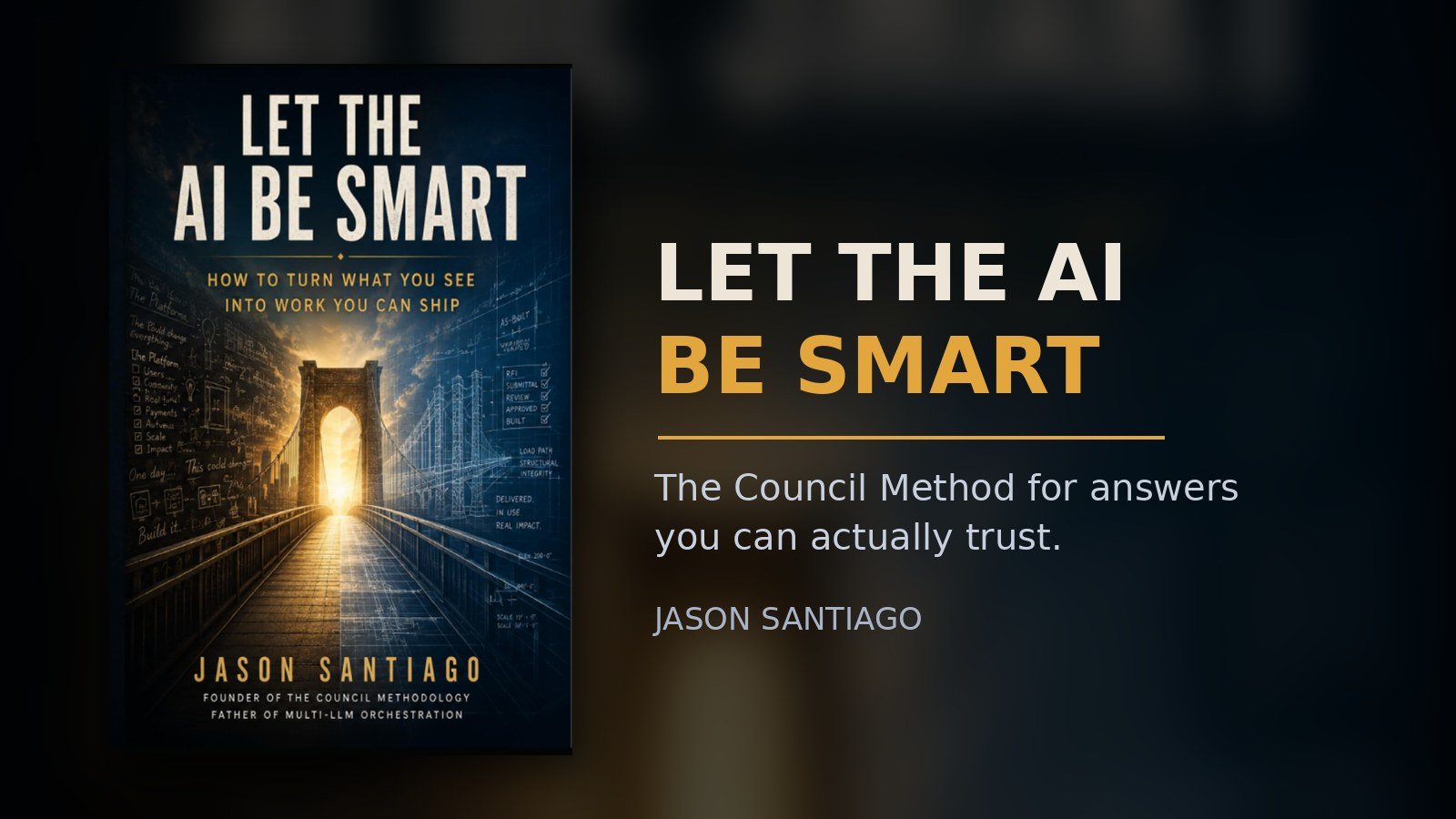
And if you want the whole method, the one that came out of that server and now runs on everything I build, that is what Let the AI Be Smart is. This site teaches the Council Method for free, and there is a companion piece on the harder truth underneath it: agreement is not verification.
Three AIs kept breaking my apps because each one trusted itself. The fix was to stop letting them. That fix has a name now, and it is the reason any of it works.